
Beforeword: This post is a reflection on the ultimate gift—a bilum. I came to know that bilum doesn’t hide the truth, it just places it underneath. The front- and undersides are real. But only one side shows the cost.
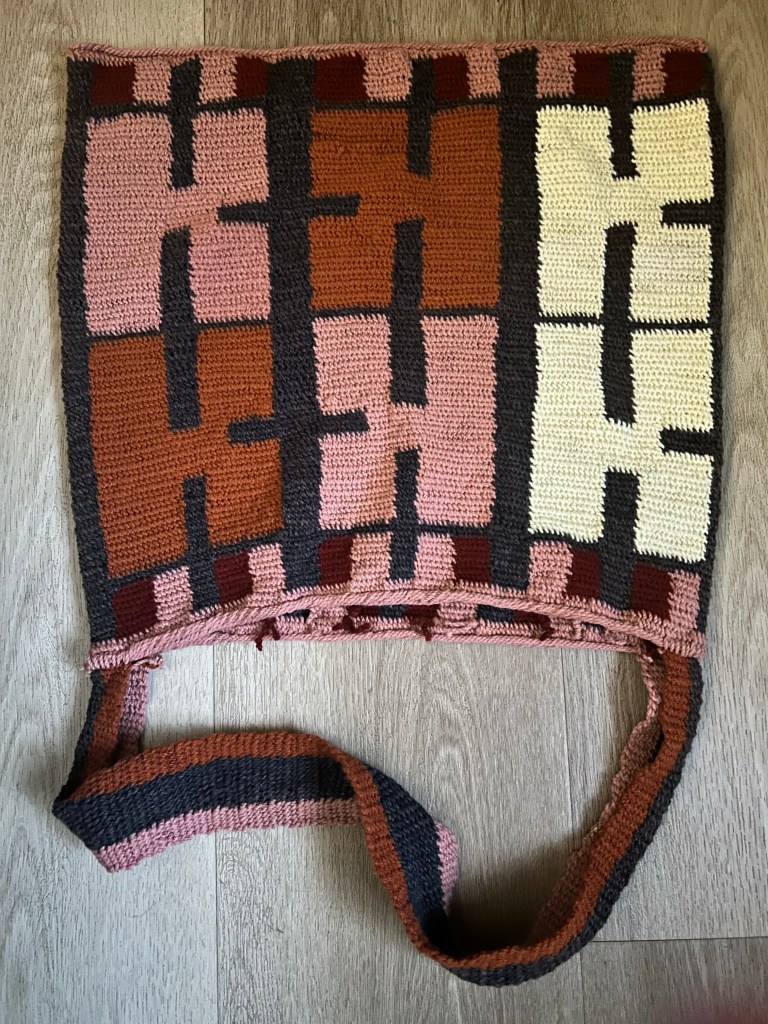
When was the last time you had a surprise that both blessed you and took you back in time all at the same time?
For me that was a couple weeks ago. Of all the things I expected to happen while attending the Women Deliver Conference, I did not expect a gift to find me.
With nearly six thousand people moving through that space, what were the odds of running into someone you didn’t even know was looking for you? Slim, at best. And yet, that is exactly what happened.
This post is about the joy of that unexpected encounter, the deeper meaning of being “found,” and the lessons wrapped in the gift that came with it.
Happenstance or orchestrated?
It was the end of the day. A colleague and I were heading away from the conference to our separate hotels when I heard my name. Not as a confident exclamation but a questioning utterance in a could-it-be-you sort of way.
They were walking just behind me. His wife was certain it was me; he wasn’t so sure—ironic, given he’s the one who had worked with me for years🙂. In his mind, she had to be mistaken. Still, he called out my name—“Dawn?”—with that cautious-half-question tone. I turned, and there he was. One of the best blasts from my past, standing right in front of me.
When he heard I was coming to the conference he started thinking of how to find me while keeping the surprise in tact.
He’s a former staff member—someone I once supervised, but more truthfully, someone I had a meaningful working relationship with and had also connected with his family. He and his wife had talked through how to find me. The logistics didn’t make sense. The crowd. The schedule. The constant movement. And the day didn’t cooperate. Or so it seemed in its unfolding.
Delays. Missed timing. A few turns and twists. And then—there we were. Face to face. Without scrambling, without confusion. The meet up happened through what we each agreed was nothing short of a divinely-orchestrated unfolding.
A bilum
He and his wife didn’t only talk about how the meet up may happen, but also what to gift me.
Before that moment, I might have called it a bag. Something handmade. Something beautiful. But he didn’t approach it casually, and that made me pay attention. He told me he had bought more than one. He wanted me to choose what felt right to me. That level of care told me this wasn’t about the object—it was about what it carried.
What it carried was meaning.
In Papua New Guinea, a bilum is a traditional handwoven string bag. It’s made using a looping (not knitting or weaving in the usual sense) technique that creates a flexible, expandable net-like structure.
In Tok Pisin (one of PNG’s main languages), “bilum” literally means “womb. That’s not poetic exaggeration—it’s functional and symbolic and how it is to be understood:
- It stretches, it adapts, it carries weight without losing form.
- It holds life—food, goods, babies.
- The bag sits against the body, often supported from the head.
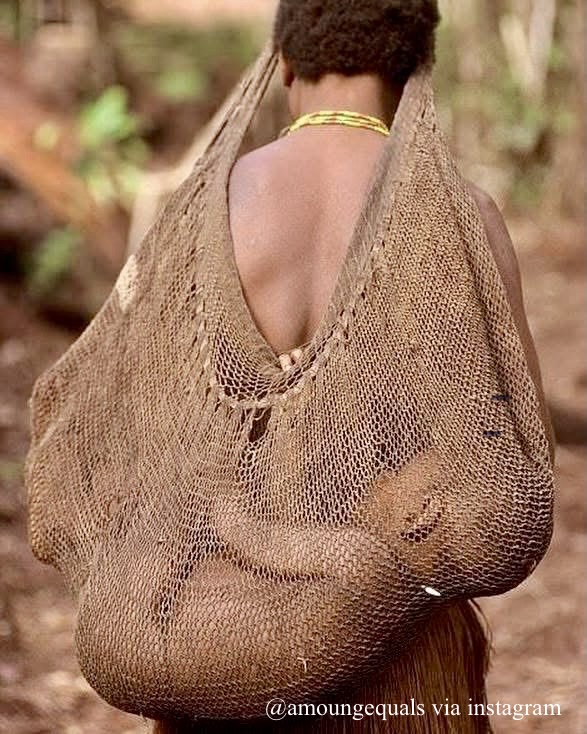
So the bilum becomes a physical extension of care, protection, and survival.
It is made by women
His wife went on to explain that because of the high levels of intimate partner violence—which affects 80% of women (a rate that may be the highest in the world) many women use the creative process of making the bilum to speak their pain into the process. In so doing they have woven the unspoken stories into these bags—truths society does not always openly acknowledge.
You may never hear her voice directly, but carry that bilum into the world and her message goes with you.
What looks simple is actually built through repetition, patience, and intention. You don’t rush a bilum. You build it. Not quickly. Not casually. Each strand prepared, each loop formed by hand. In that regard, no two are the same. Each carries the individual decisions, rhythm, and emotional imprint of the woman who made it.
They both concur on this point: the bilum/womb I’ve been gifted is unique and it’s connected to a specific woman’s story.
And as I heard this, I started to understand why this was the gift he chose.
A woman’s womb carries what is good before the world ever sees it. Quietly. Intentionally. Without applause. And in the same way, the woman who makes the bilum weaves more than fiber into her art—her thoughts sit in those loops, her intentions hold the structure together—so I should be equally as intentional in receiving this gift as heART©️.
That stayed with me.
The underside—how it looks, how it’s lived
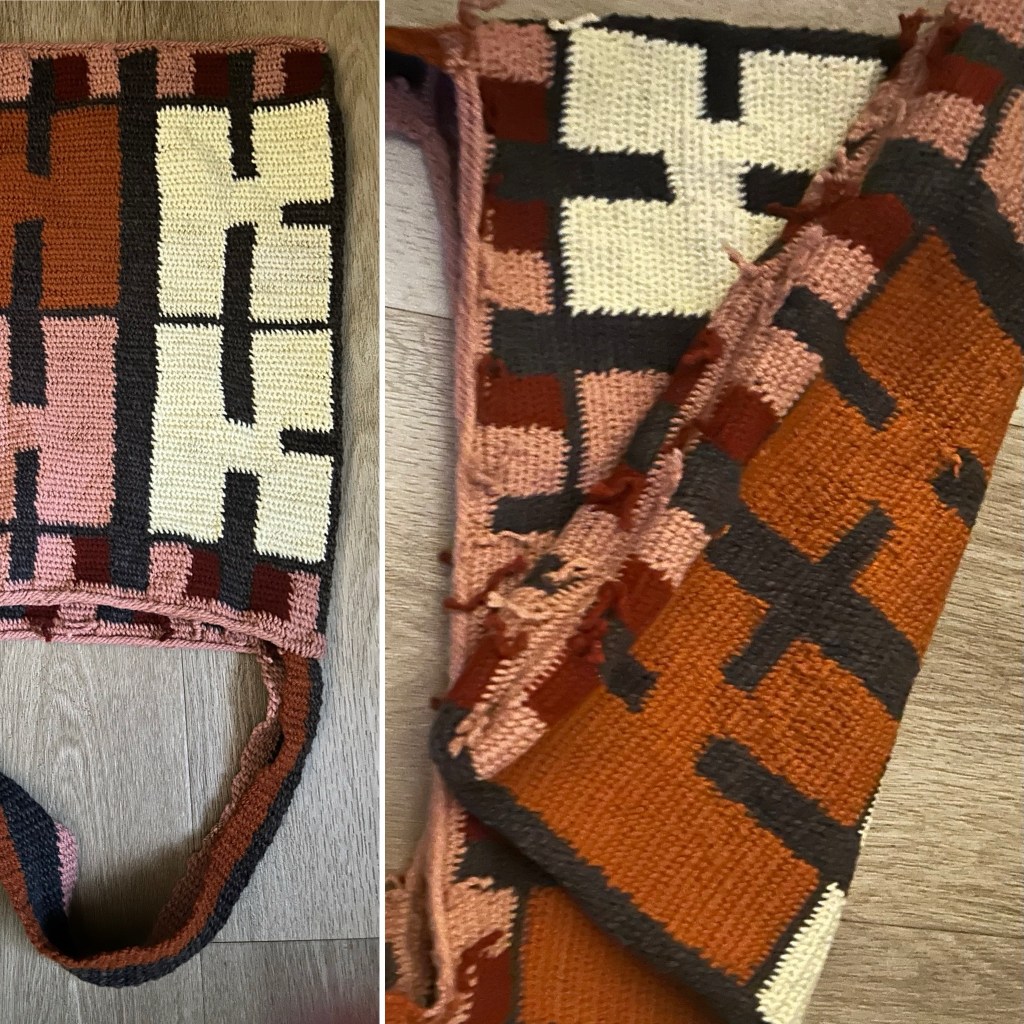
The first time I carried the bilum I noticed some fibers were exposed. My “neat girl” mind immediately went to: you should clip them off. However, I was drawn instead to examine the underside.
That’s when I discovered there’s another layer to a bilum that you don’t see until you look closer.
Turn the bilum inside out, and the underside tells a different story. Knots. Tension points. Threads crisscrossing in ways that don’t look refined or finished. It’s not what you would display. But it’s what makes the bag hold.
The outside is smooth. Structured. Coherent. The kind of beauty that makes sense at a glance. Each pattern has a symbolic meaning. Some of these are described by the UN Population Fund, that runs a #BilumCampaign:
- Diamond: represents a young girl’s journey into womanhood.
- Half diamond: is worn by young women who have already passed through puberty.
- Fallopian: inspired by the shape of a woman’s ovaries and fallopian tubes.
- Mountain: symbolic of the challenges women must overcome in society.
- Spiderweb: symbolic of the role of methodical attention and diligence in a woman’s craft.
- Skin pik: reminder of the unequal status of women in traditional PNG society.
As I’m coming to realize that bilum patterns are not merely decorative but are a visual language, I’m more and more intrigued to know the pattern of my gift. Is it communicating status, transition, grief, womanhood, resistance, becoming?
However, more important than knowing the pattern or motif, is knowing the knots, tensions, and hidden threads beneath the surface are as much a part of the story as the beauty seen on the outside. The weaving itself becomes testimony.
The inside is where the work actually sits—the pressure, the tightening, the places where things had to be pulled together to keep from falling apart.
And it struck me how easy it is to confuse the two:
- One, to look at what is visible on the outside and assume the process was just as clean. But that is only how it looks.
- And, two, to mistake the finished side for the full story. But that’s only how it’s lived.
What if I had cut off what I first saw as excess fiber? I would have missed this lesson—the bilum doesn’t hide the truth, it just places it underneath. Both sides are real. But only one shows the cost.
And maybe that’s the part I needed to hold onto most.
Seasons of knots over seasons of progress
There are seasons that feel like the underside—tight, uncomfortable, not yet making sense. The kind of moments where you can’t see the pattern, only the strain. Where everything feels like knots instead of progress.
But the bilum doesn’t come apart because of those knots. It holds because of them.
Every pull. Every loop. Every place where the thread had to be worked into position—none of it is wasted. It’s all part of the design, even when the design isn’t visible yet.
You won’t understand the pattern while you’re underneath it. You can only understand it when you come through.
So now, I don’t just see a gift. I see a reminder to trust what’s being woven, even when I’m still on the side that doesn’t look finished.
And then there’s the part I can’t ignore.
I received a womb at Women Deliver
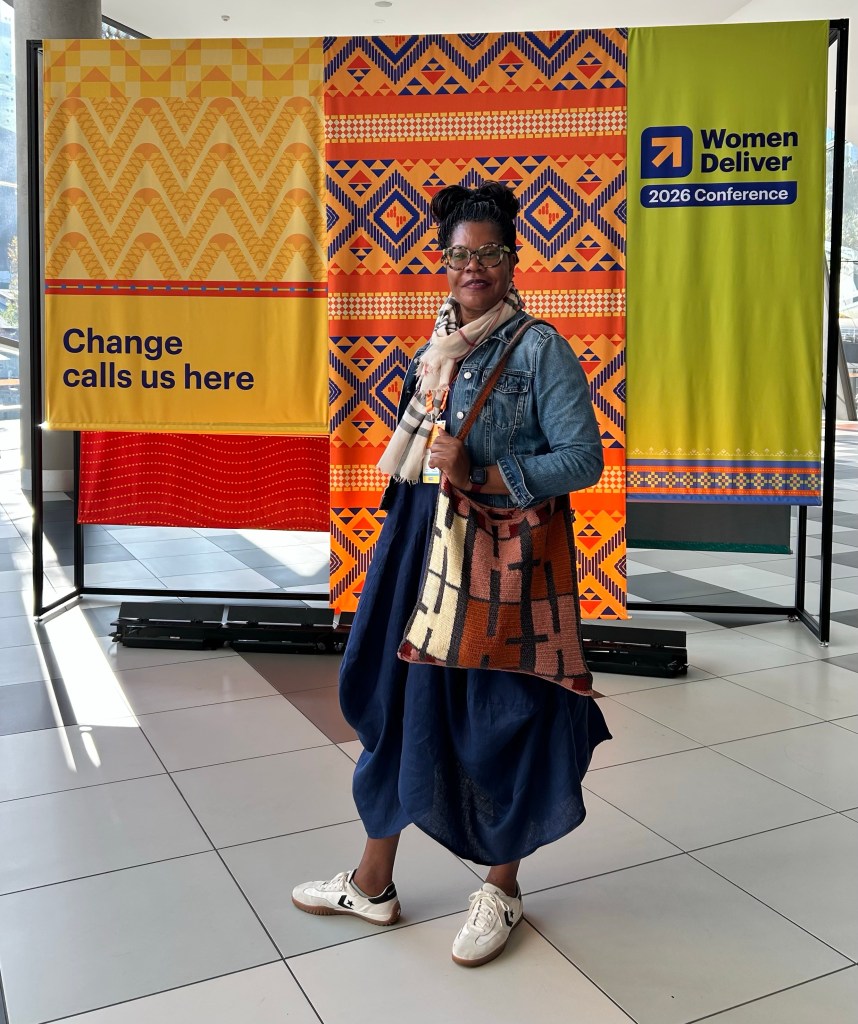
That alignment is too precise to dismiss. First, because it reinforced that “women deliver” far more than babies:
- They deliver stability into homes, often through unpaid care that is not systematically tracked.
- They carry emotional weight for families, workplaces, communities—holding space, smoothing tension, anticipating needs before they are spoken.
- They deliver ideas, solutions, resilience.
- They show up, again and again, in ways that are expected but rarely named.
- What they carry is constant. What they produce sustains more than we often acknowledge.
And second, because a womb means something is being formed. Something is being carried before it is revealed. Something is in process, whether or not anyone else can see it yet.
And if this bilum carries anything, it carries that truth.
My bilum’s pattern: becoming
After reviewing a few bilem patterns mine seem to resemble a Skin Pik variation:
- the rectangular segmented blocks,
- the earthy tones,
- the strong black dividing lines, and
- the structured geometry.
A pattern born from women being diminished…now becoming a gift carrying affirmation, voice, memory, and destiny.
What is being woven now—quietly, intentionally, even through the tension—is not random. It is on its way to becoming.
2026 All Rights Reserved
Like what you see? To never miss a post click HERE👈 to subscribe & follow the blog. There’s more HERE👈 and on Spillwords, the Writers Club, Facebook & Bluesky.
In creative solidarity, Dee💡 Only WordPress.com members can hit the “Like” button, but everyone’s welcome to share their thoughts in the comments. Thanks!
 Poems & More
POWERFUL STUFF!! And YET another reminder that there are NO coincidences, just Creator and universe GIFTING us those things AND people we need, when we need em the MOST!!!! BEAUTIFUL story; EVEN more beautiful Bilum!! Mi LUBBIT!!!!
LikeLiked by 1 person
You know it!!!! all things working together for good.
LikeLike
A wonderful meeting, gift, and post on “becoming”! I love the idea of a “womb” bag and that women “deliver” in many ways. ❤
LikeLiked by 2 people
Thanks Lynn!!!! Appreciate you stopping by and engaging. D
LikeLiked by 1 person
My pleasure, Dawn!
LikeLiked by 1 person
🤗💖🤗
LikeLike
What a beautiful post, Dawn, and I learned something new today too. That is a beautiful gift – the colors are gorgeous and warm, and I love the profound meaning that comes with it. Thanks for sharing! ❤️
LikeLiked by 1 person
Hi Lauren. I also learned a lot from researching this gift. Thanks for stopping by and engaging.
LikeLike
Powerful post, Dawn, I’m speechless. 🙏🏼 Thanks for sharing the intricate depth of your gift.
LikeLiked by 1 person
Thanks dear Eliza!!! I’m glad it resonated with you so deeply. Have a blessed week ahead. 🙂💕🙂
LikeLiked by 1 person
Dawn, this is deep. I love the way you use these seeming happenstances to weave in important life lessons and interconnectedness. With your work, with real life issues. Absolutely love the Bilum/Womb story. Brilliant! Keep writing. Keep educating.
Norma.
LikeLiked by 1 person
Hi Norms. Thank you. It’s revelation. Nothing happens in ourselves by chance. The more we pay attention the more revelations we get. Thanks for being there to receive and reciprocate. Big hug 🤗
LikeLike
All this is just amazing Dawn. Serendipity , I’d say in the best possible way.
LikeLiked by 1 person
Yes indeed my dear Sadje!!! Happy new week my friend!!! 💕🙂💕
LikeLiked by 1 person
Have a lovely week
LikeLiked by 1 person
Thanks much!!!
LikeLiked by 1 person
💞💞💞
LikeLiked by 1 person
What a beautiful and practical bag!
LikeLiked by 1 person
Yes indeed it is!!!
LikeLiked by 1 person