
Beforeword: Fantasy in Hobbiton. Island bliss in Waiheke. And landscapes so extraordinary it’s like somewhere beyond this world. New Zealand—thank you for a remarkable glimpse.

New Zealand — an island nation in the southwestern Pacific, feels otherworldly in the truest sense of the word.
My take? Mother nature conspired with geography and created landscapes that were too cinematic for the human mind not to conjure up fantasy.
And fantasy was exactly what I came seeking.
The one experience I pre-booked before arrival was the Hobbit Movie Set. Everything else—whatever it turned out to be—would simply orbit around that.

From flights over the island to drives through the countryside, the nature lover in me was awed—jagged mountains against lush green valleys. Rolling farmland that stretched lazily into the horizon dotted with sheep and cows grazing. This is dairy country for sure. The taste of their ice cream and cheese confirmed it.
Because I visited in fall, I experienced the variations of nature’s moods all in a single day—sunshine and drizzle, warmth and chill, blue skies and grey clouds.

On my flight into Auckland I was fortunate to be seated beside a Kiwi, and somewhere between takeoff and landing he became my unofficial guide to New Zealand.
So engaging was our exchange that I forgot entirely about filming the aerial approach as he proudly pointed out his own house nestled among the rolling hills.
“Breathtaking,” I said.
The flight attendant sitting across from us (the emergency seats) who had interjected in our conversation as we came into the landing, nodded in agreement.
Again I left room for what locals would recommend and so my Air New Zealand seatmate unexpectedly helped shape my New Zealand experience.
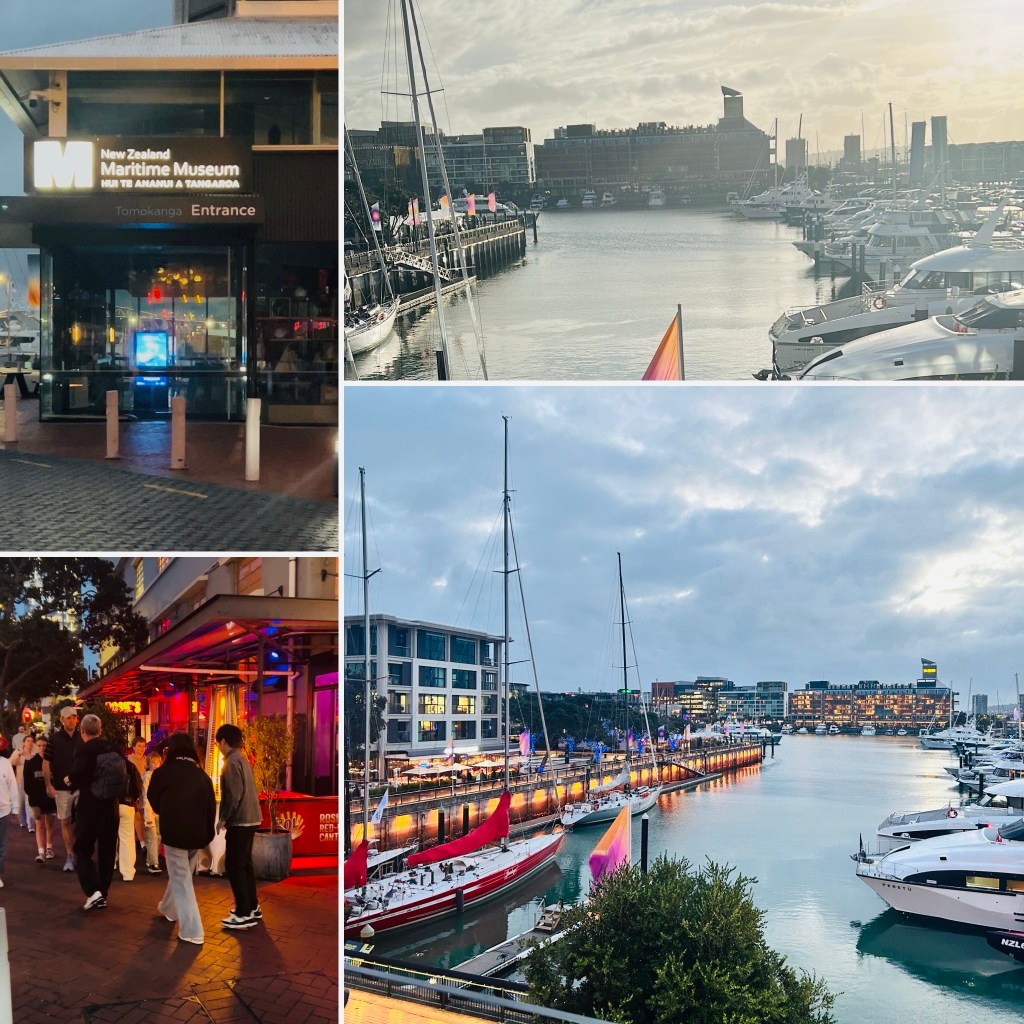
My time there was brief—far too brief to claim I truly did New Zealand justice—but it was enough to quench a particular kind of wanderlust: the longing for fantasy, the pull of my island-girl spirit, and landscape so extraordinary it feels—well, otherworldly!
Into Middle-earth: The Hobbit Movie Set
Before The Lord of the Rings took the movie world by storm there was The Hobbit—a fictional species resembling short humans with furry, leathery feet who live in underground houses and are mainly farmers and gardeners.
What began as a bedtime story that J. R. R. Tolkien invented for his children grew into one of the most beloved fantasy novels of all time, laying the foundation for the vast mythology of Middle-earth. So naturally, I found myself heading into rural New Zealand to experience that imaginary world firsthand.
The journey from Auckland to the Hobbit Movie Set felt like an unveiling of sceneries—but one I nearly missed.
According to Google Maps, my hotel was just a ten-minute walk from the pickup point. Confidently, I decided to walk, thinking it would also give me a chance to absorb a bit of Auckland in the process. Now, following directions has never quite been my strength, but surely—with a generous buffer—I could not possibly be late.
That was the theory.
Reality looked very different.
I arrived in the nick of time huffing and puffing after yet another dramatic sprint to avoid missing transportation, and while traveling at that! Lucky me because the driver left exactly on time. Two other would-be passengers were not as fortunate.
I settled into my seat and enjoyed the delicious breakfast my hotel had packed for me while watching the city gradually dissolve into countryside. And so the unveiling of sceneries began: skyscrapers gave way to winding roads, grazing sheep, and farmland so green it almost looked digitally enhanced (who knows in this AI age, right).
Then came one of those stories that feels too perfect.
The famous movie set sits on the Alexander family farm, and as the story is relayed by our guide, fate—or extraordinary luck—played a role in its discovery. When filmmakers searched for the ideal setting for Hobbiton, they considered locations that reflected Tolkien’s imagined world: rolling hills, pastoral calm, and storybook charm.

The Alexander farm stood apart because it had everything in one place—including the magnificent tree that would become central to Bilbo’s famous party scene. Rather than having to piece together landscapes from multiple locations, filmmakers found a setting that already seemed to belong to Middle-earth.
The bus ride from the visitor center only heightened the anticipation. With every hill we crested, I scanned the landscape for clues that the village might be near.
And then—there it was.

The set up is as if Middle-earth had existed there all along, and not part of a movie set on a working farm. Unlike other movie sets that must be torn down after production ends, this one could stay up in its entirety.
What struck me most was the astonishing attention to detail.

This was not a hastily assembled movie site. It was so perfect I’d say even obsessively so. Every fence post, garden path, vegetable patch, stain glass window and weathered detail seemed placed with purpose to remain faithful to Tolkien’s descriptions. We learned that when nature did not cooperate with the vision, filmmakers simply created what was missing—including an apple tree and another huge tree that had to be constructed where none existed so the setting would feel true to the world Tolkien imagined.
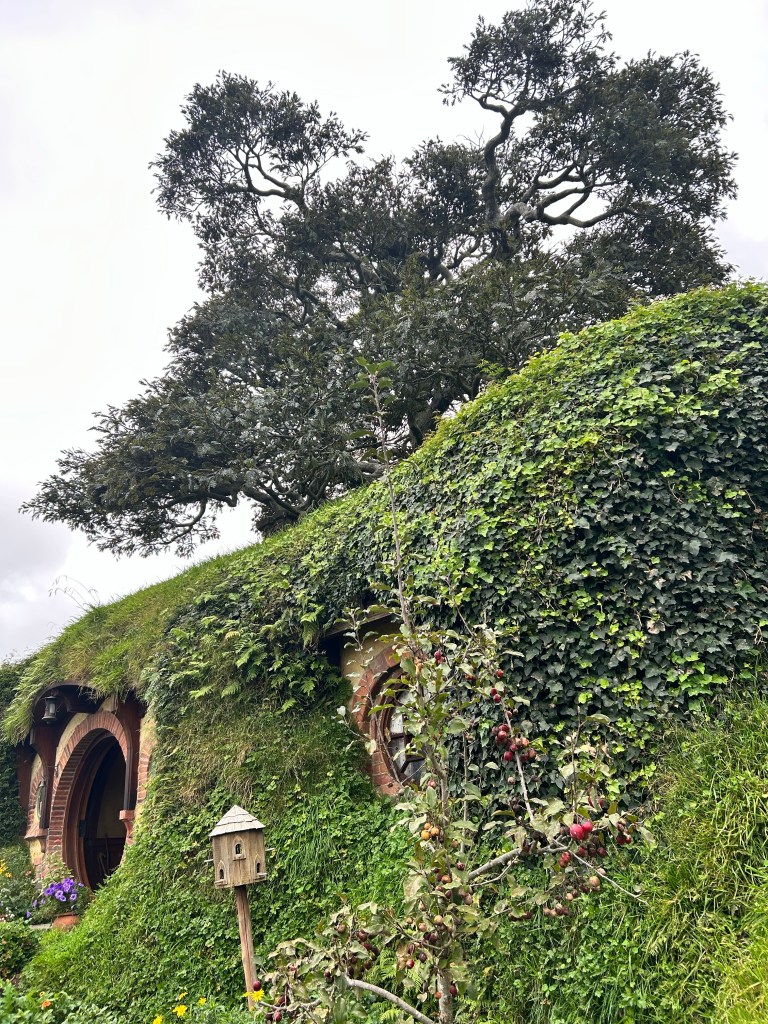
Definitely faux!
Fantasy, here, was precise.
Walking through Hobbiton felt delightfully disorienting. Tiny round doors and stained glass windows dotted the grassy hillsides. Laundry fluttered on lines. Gardens overflowed with flowers and vegetables, making the village feel lived in rather than staged.

And then there was me—very much reminded that I am not, in fact, a hobbit.
Inside one of the hobbit homes opened to visitors, my height became the reference for warnings of: “Watch your head”! I found myself bending and ducking to fit comfortably into spaces clearly designed for residents much shorter than me. It added to the charm somehow—the physical reminder that this world was built intentionally small, inviting visitors not only to see fantasy but to briefly inhabit it.
For a few hours, my imagination and my love for architecture were one.
Waiheke: A Day of Island Ease
After wandering through fantasy, I traded Middle-earth for island ease.
When time is not on your side but curiosity is, a thoughtfully designed day tour can become the perfect compromise. So it was with Waiheke.

Just about 40 minutes by fast ferry from Auckland, Waiheke Island feels worlds away from the city despite its proximity. The ride itself was quick and because of the weather quite choppy as the ferry bobbed and weaved, slicing through the water as Auckland slowly receded behind us and island life beckoned ahead.
Known for prestine beaches, vineyards, olive groves, and relaxed coastal beauty, Waiheke was a welcome reprieve from the city.
I visited during the off-season, which gave the island an intimate feel. Our guide pointed out that the short five-minute drive through the main town could stretch to thirty minutes during peak tourist season—a reminder that I was seeing Waiheke in its quieter, gentler mood.
The Taste of Waiheke Day Tour packed a surprising amount into a single day: sightseeing across the island, private transport, vineyard tastings at two of Waiheke’s celebrated wineries, an olive oil tasting at an award-winning grove, and a two-course lunch that felt far more elevated than the standard tour fare.
The views alone were worth the trip.
Vineyards rolled across hillsides toward the sea. Beaches framed by dramatic coastlines. Even under gloomy fall skies, the island’s beauty couldn’t be masked.

We visited wineries including Mudbrick Vineyard and Restaurant and Batch Winery, but, what lingered with me most was not the wine itself.
I usually book wine tours because from my experience I’ve found they tend to attract a fascinating genre of people. There is something about beautiful vineyards that encourages strangers to become companions. And when you solo travel and want to have connections what’s better than an activity that brings together the curious, the conversational, the temporarily carefree. By day’s end, our group felt less like tourists sharing transport and more like old friends sharing an experience. We even joked of pooling our resources to purchase one of the beautiful, very expensive, beach homes our guide drove us by.
That unexpected camaraderie became part of the memory.
The weather may have been gloomy, but the company, scenery, food, and laughter was sunshine enough.
New Zealand deserved more time than I could give it.
Yet even in a short visit, it managed to satisfy a longing to wander through worlds imagined and real, to step inside stories once read, and to be reminded that Mother Nature prides herself on her power to astonish.
Fantasy in Hobbiton. Island bliss in Waiheke. And landscapes so extraordinary it’s like somewhere beyond this world.
New Zealand—thank you for a remarkable glimpse.
2026 All Rights Reserved
Like what you see? To never miss a post click HERE👈 to subscribe & follow the blog. There’s more HERE👈 and on Spillwords, the Writers Club, Facebook & Bluesky.
In creative solidarity, Dee💡 Only WordPress.com members can hit the “Like” button, but everyone’s welcome to share their thoughts in the comments. Thanks!
 Poems & More
I’m a Tolkein fan so your visit to Middle Earth intrigued me…glad I got a glimpse through your photos and description, Dawn 🙂
LikeLiked by 2 people
Wow Lynn. So glad I could contribute to your Middle Earth experience. Cheers
LikeLiked by 1 person
Thank you for sharing your adventures, Dawn! I’m so glad you enjoyed your trip.
LikeLiked by 2 people
Hey Natalie. Thanks for stoping by. It was a great adventure!!! Cheers
LikeLike
Thanks, Dawn, for painting such a vivid picture of your New Zealand vacation. I felt like I was there too.
LikeLiked by 2 people
Then mission accomplished! These are written more like travel memoirs rather than a standard travelogue—so that the experience feels lived, not simply described. Thanks for confirming that’s how this piece was received. Cheers 👋🏾
LikeLike
Wonderful to hear that you made it to NZ. We were there last April for five weeks and had such an amazing time. The tour of Hobbiton was one of our highlights. Glad to hear you had a fantastic time there as well. They really brought the magic of Tolkien’s Shire to life.
LikeLiked by 2 people
They definitely brought Tolkien’s world to life. 5 weeks!!!! So you really got to experience the country uh?! Did you blog about it? Would love to read about your visit.
LikeLike
How wonderful, Dawn! Glad you had a great time. I have a friend who grew up on the South Island near Christchurch. The beauty of NZ is legendary!
LikeLiked by 1 person
Hi Eliza. I only made it to Auckland! I wish I could have spent more time. Legendary is the best descriptor!!!!
LikeLiked by 1 person
Beautiful! What a wonderful visit. Thanks for sharing this.
LikeLiked by 1 person
Hi Anneli. Thanks for stopping by. Glad you enjoyed reading about it. Cheers
LikeLiked by 2 people