Shalom isn’t just a greeting—it’s a name that points us to who God is. Shalom means peace, wholeness, and completeness, and our God is the God of Shalom—the God of peace.
But what happens when our lives feel shattered, when everything around us seems to be breaking apart, and peace feels out of reach?
In those moments, remember: the God of peace is also the God of piece. Piece by piece, He gathers the scattered, broken parts of our lives. Piece by piece, He heals our wounds, restores our hope, and puts us back together. Piece by piece, He makes us whole.
God’s peace is not a fragile stillness that fades when storms come. His peace is a powerful, steady presence that guards our minds and hearts, even when the world shakes.
“And the peace of God, which transcends all understanding, will guard your hearts and your minds in Christ Jesus.” —Philippians 4:7 (NIV)
This Sabbath, may you turn to the God of Shalom. Trust Him to take every broken piece of your story and restore it, until His perfect peace fills your life.
Shabbat shalom.
2025 All Rights Reserved
Designed with Canva
Images by Pexels
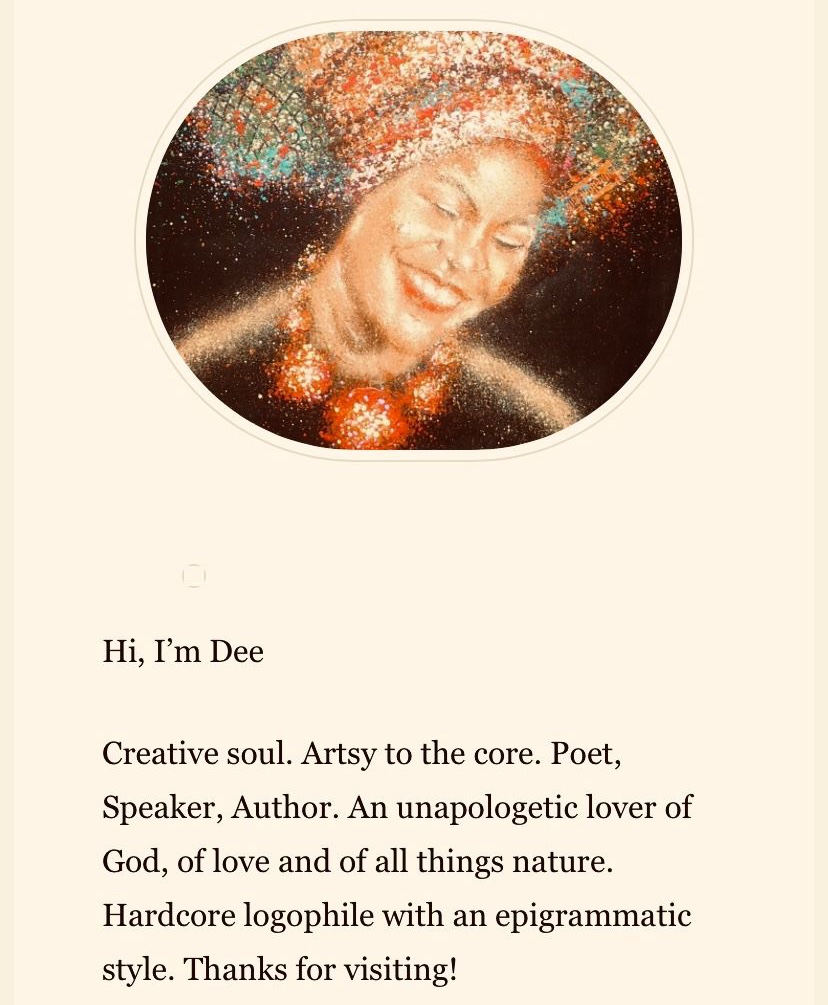
Beforeword: Hello reader!!! So if you’ve visited the “About” page of this blog, you’d have seen my profile.
Well, I’ve now transformed the “About” page into this poem. I hope you enjoy it!!!
“A Creative Soul’s Embrace”
In creative spaces I find my solace and delight Words—a poet’s heart, a blogger’s guiding light A speaker’s voice, in stories unfold My pen, a vessel, for tales yet untold
In “Moments: A Poetic Autobiography”I share My thoughts, my verses, my joys, my care Unapologetically, a lover of the Divine My adoration of God, evident in every line
Love’s tender embrace—my muse, my song In verses, I’ll celebrate it all the day long Nature’s beauty, a treasure trove to explore In each flower, in each leaf, a story I’ll implore
A logophile, yes, words are my kin In dictionary’s depths, I always begin Epigrammatic style—concise and clear My poetic soul is forever sincere
Creativity flows, an endless tide In art and words, my heart doth glide Artsy to the core, in colors and rhyme I paint my world, one verse at a time
So here I stand, a creative soul’s embrace Of poetry, of prose, of words, interlace Whether as a poet, a blogger, a speaker, or more My love for words, I will forever explore
Whether tears are as a consequence of joy or sorrow, they speak volumes—even more than words can say.
As I mentioned in last week’s Shabbat Shalom post, I was writing it from my own heart experience. What I didn’t say was that it was written with tears.
(You may read that post, “Shabbat Shalom: comma-but-God” 👉here.)
Yes, I do mean to say “with” tears.
The many reactions that last week’s Shabbat Shalom post evoked is testimony to this—tears have the power to trigger human connection. And God uses tears to connect human experiences for healing and restoration.
Humans are the only species born totally incapable of helping ourselves. At birth and in the early stages of life we are vulnerable and physically unequipped to deal with anything on our own. Instead, we cry to signal our need for help.
As adults, we oft times face issues and problems that are beyond our ability to cope, at least temporarily. And, in those instances it’s as if we’re babies again. And, we cry. Emotional tears say: “I’m vulnerable. In this moment I’m beyond my own capacity to help myself. I need help. I need you.”
Tears have a voice.
The very essence of being human, is the ability to cry emotionally, and on the other hand being able to respond to the emotional tears of another.
In writing last week’s post with tears, though I didn’t say it, the tears actually spoke through. It triggered connection and generated the most deeply personal responses which came not only through the website but to me, personally, as SMSes and voice notes as well.
Before last week’s Shabbat Shalom post, I had written over 350 other posts on this blog. But never one written with tears.
So the reactions to this post made me realize that tears when shed from intense emotions, will not return empty, but will reap a harvest.
Tears have a harvest.
The Psalmist David says it this way—God collects our tears and bottles them.
David didn’t pull the concept of bottling tears from thin air. No. It was a tradition of his time and one which dates back to almost 3,000 years. A tear bottle, or a lachrymatory, (from the Latin lacrima, ‘tear’) is a small vessel in which mourners are said to have collected their tears.
Going back to the concept of God bottling our tears—as I mulled over all the responses from last week’s post, and contemplated on the reference to God bottling our tears, two object lessons stood out for me which I’d like to share with you today.
Lesson I: Tears cannot be collected from a distance.
God is deeply concerned about us. When we hurt, when we cry, He takes note of every hurt and collects and bottles every drop of tear. And I think it’s because our tears take our Father—our DaddyGod—back to the point of our deepest vulnerability. He sees us in a state of baby-like-ness which evokes that God-to-human connection, and He draws near.
Now, I don’t think God actually has a collection of bottles. But, what I think David was alluding to when he wrote this, was the remembrance of God. And in His recollection, God redistributes our tears to water the heart-soil of others who are hurting from a similar pain. And He then opens opportunities for us to share from our point of pain to the point of restoration in others.
Whether it be that He influences the mind of a blogger to write from her heart-pain or He directs a reader to share, starting a chain reaction of heart restoration—whatever it is, God uses tears to trigger the human-to-human connection.
Tears, in deed, cannot be collected from a distance.
Lesson II: Tears beget harvests.
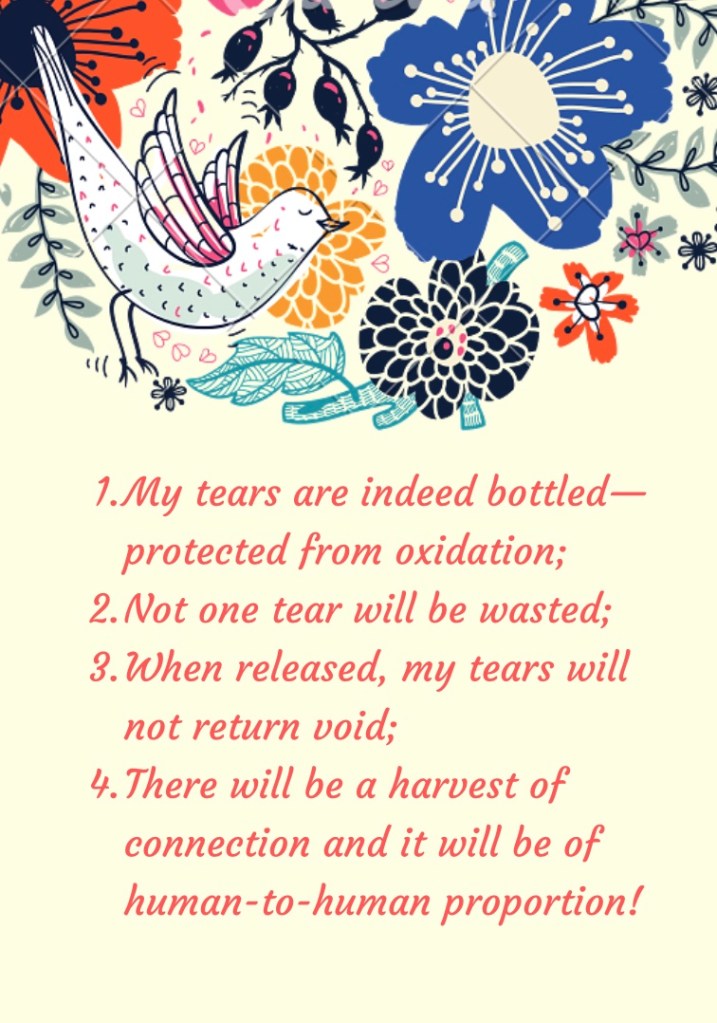
The bottling process has one very clear objective. In the case of wine (which was the first example that came to mind), the objective of bottling is primarily to protect the wine from oxidation for as long as possible. In simple terms, oxidation iswhen oxygen combines with an element and changes its appearance.
The central theme in all the responses to last week’s Shabbat Shalom post was this: the message came at just the right time. Each person from a different experience, yet each connected to the post to the extent to which it spoke to their specific need.
No tear is lost. They are bottled—being protected by God from oxidation until it’s time for them to reap a harvest.
Every tear is a story—big, small, or in-between—that God takes note of and that He remembers. And He releases them on the wings of oxygen. Oxygen is the life-supporting component of air. When God releases your story, the process of oxidation changes the appearance of your story to mirror the need of the intended recipient. And in so doing, the tears of your one story can speak to the hurt of so many others. Why? Because tears beget harvests.
I believe that when tears “speak”, that’s God!
For us there is no way to number the myriad things that cause us to shed tears. Not so for God. He knows every cause and He is the cure.
Not only does God sing and dance over us in the upbeat times. But, because of the caring loving parent that He is, He keeps track of our downbeat times, and He finds creative ways to ensure our tears reap their harvest.
Reflection
Last week I wrote to you with tears from a “comma” moment—a pause at a juxtaposition between the angst I was feeling and the “but God” intervening that’s in the unfolding.
Having experienced how my tears spoke to and watered the heart-soul of so many others, today I write to you still from a “comma-but-God” life-place, but with these assurances from God:
Shabbat Shalom. May you find your own assurances that God is intimately concerned with every aspect of your life. He’s equally involved in your joy-times as He is in your sorrow-times. It may be hard to see it sometimes, but trust that He extends His graciousness and compassion by intervening against the challenges of your life at just the right times.
When your tears speak from sorrow, hurt or pain—it doesn’t matter how big or small, how trivial or important—God listens and He wants to intervene. I hope you’ll let Him.
T-shirts are arguable the most functional piece of clothing in our closets. More recently I’ve come across Tees used as signposts for thoughts/feelings/stance on a range of issues making them artistic creative statement apparels.
Statements like:
Unapologetically dope
I never lose, I either win or I learn
Periodt. [oh yeah, when the “t” is added (“periodt”), you know no further discussion will be tolerated]
I’m not for everyone
I love the skin I’m in
Classy but thou shalt not try me. Mood 3:65 [I really like this one, it’s feisty with a nod to “commandment”-level caution/warning]
You want my rhythm?! You gotta take my blues.
Black lives matter
So it seems whether solidarity or protest, whether reclaiming space or questioning narratives, the messages we champion on our chests can contribute to how we’re understood in the world.
Particularly when you’re part of any group that has been OTHERED in the mainstream, the message on a T-shirt is one way to articulate a point without a direct action (like the caveat to start what may otherwise be a difficult conversation).
Whether challenging racial inequality or promoting body positivity or questioning gender inequities, when you can mirror what you think/feel (emotional level) with words prominently worn on your chest/close to your heart (aesthetic level), it’s as if your WHOLE self culminates in your fashion choice.
Here’s a fun post. When you want to say “I love you” and your sweetheart is all kinda SWEET, say it creatively with candy wrappers.
You’re that EXTRA-special kind o’ LOVE STARBURSTing emotions Sending heart waves into a pleasurable SYMPHONY of ORBIT JUICY FRUIT kisses Out of this world MILKYWAY delish You make each relationship day feels like PAYDAY Nobody better not lay a finger on my BUTTERFINGER No one or anything will come beTWIX this MUNCHable LIFESAVER HARD CANDY kinda love
This blog, titled "Empowering Leadership: Building a Harmonious Partnership Between School Management and Principals," explores the essential factors that foster a strong and effective relationship between school management and principals. Drawing on historical context, philosophical principles, Indian legal frameworks, and mythological analogies, the blog offers insights into creating a balanced dynamic where principals are empowered yet accountable. It provides practical strategies for ensuring the administrative, academic, and financial health of educational institutions through clear communication, shared vision, and mutual respect.













 Poems & More